


Expansion across regions used to mean replicating your entire operation: new servers, new infrastructure, new everything. In 2026, the operators who serve multiple regions do it from one backend. The panda master online game platform runs on a multi-region cloud architecture that delivers global reach with regional performance—low latency, local data handling, and unified management. For distributors looking to buy panda master software license and expand, this architecture removes the infrastructure barrier entirely. This guide explains how multi-region cloud serving works and what it means for distributors.
The Infrastructure Barrier to Expansion
For most distributors, the barrier to entering a new region is not demand; it is infrastructure. Running servers in a new country means procurement, maintenance, security, and compliance overhead. A single-region setup cannot serve distant players without latency that kills the experience. The result is that many distributors stay local not because they lack ambition, but because the technical cost of expansion is too high. Multi-region cloud architecture removes that cost.
How the Multi-Region Architecture Works
1. A Unified Backend with Distributed Data Planes
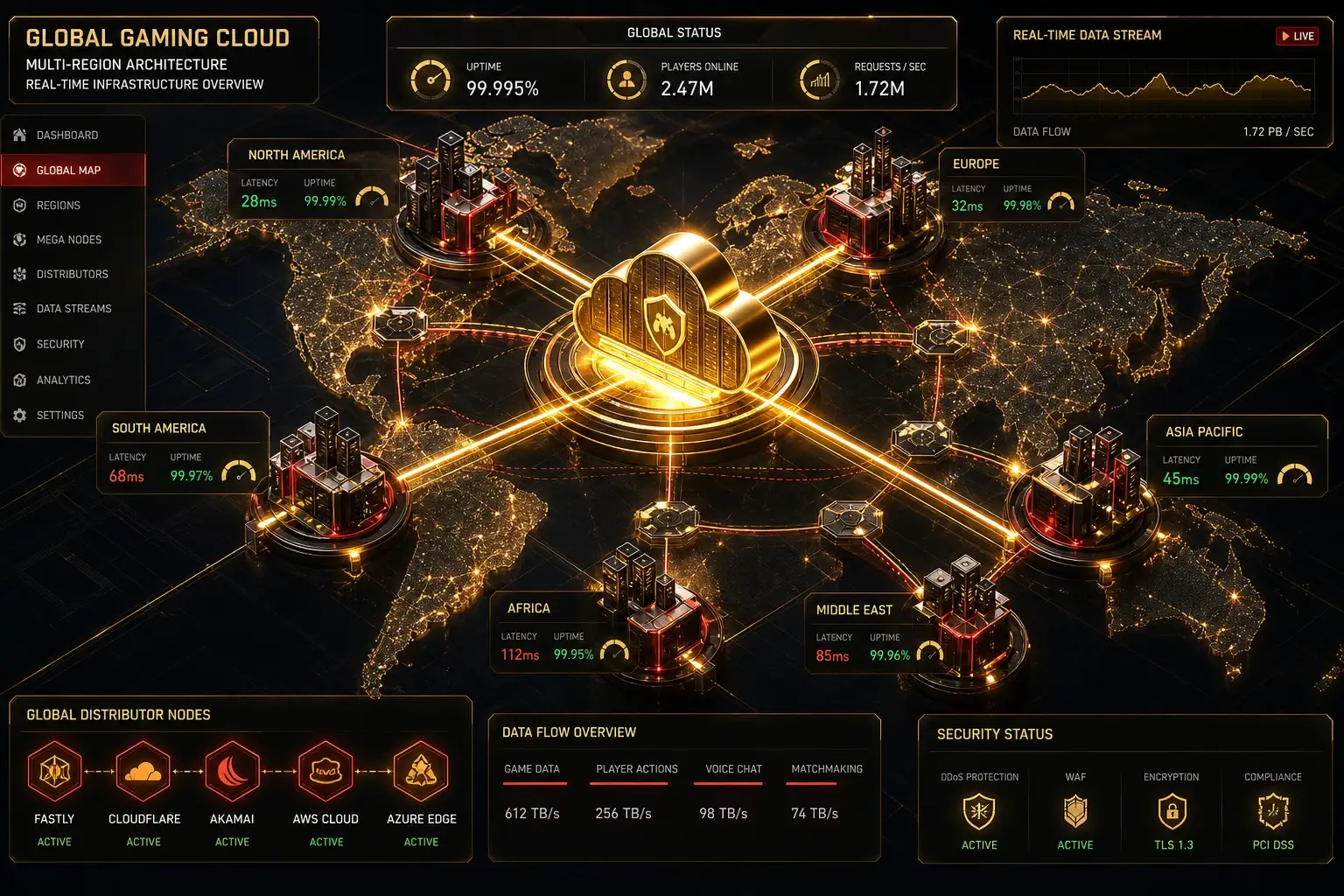
The platform operates one logical backend while deploying data planes in multiple regions. Game logic and management stay centralized for consistency; player-facing processing happens at the regional edge for speed. This architecture delivers the best of both: one operation to manage, and local performance for every player.
2. Regional Performance Without Replication
Your players in different countries connect to the nearest regional plane, reducing round-trip latency dramatically. A player in Southeast Asia gets the same responsive experience as a player in North America, without the distributor managing separate server fleets. The performance benefit of local infrastructure is achieved without its operational burden.
3. Data Residency by Design
Regions increasingly expect data to be handled locally. The architecture supports regional data residency, keeping regulated data within its region while the unified backend maintains the operational picture. For distributors entering markets with residency expectations, this is a compliance enabler rather than an obstacle.
What Distributors Actually Get
When distributors buy panda master software license, the multi-region architecture is included, not bolted on:
- Global coverage: Serve players across regions from day one, expanding without new infrastructure projects.
- Unified management: One dashboard for every region, one reporting layer, one set of controls.
- Elastic scaling: The cloud automatically absorbs growth—a viral moment in one region does not require manual provisioning.
- Operational simplicity: No server procurement, no maintenance windows, no regional tech teams.
The Economics of Multi-Region Serving
The financial case mirrors the operational one. A distributor expanding to three regions traditionally multiplies infrastructure spend. With a unified backend, the incremental cost of serving a new region is marginal: configuration rather than construction. This changes the expansion math, making regional growth viable for operators who previously could not justify the infrastructure investment.
Expansion Checklist for Distributors
- Validate demand: Confirm the target region has the player base and regulatory posture you can serve.
- Configure the region: Activate the regional data plane and apply jurisdiction settings.
- Test performance: Verify latency and experience from the target region before launch.
- Launch and monitor: Enter the market and use the unified dashboard to monitor regional performance.
Case Pattern: The Distributor Who Expanded to Three Regions in One Quarter
The practical power of multi-region architecture appears in the expansion stories of 2025-2026. One distributor had operated successfully in a single region and saw clear demand in two adjacent markets. The traditional path—procuring infrastructure in each new region, building local technical teams, maintaining separate server fleets—would have taken quarters and significant capital, and might have killed the expansion before it started.
Because the distributor’s license included the multi-region capability, the expansion looked different. Each new region was activated as a configuration: the regional data plane enabled, jurisdiction settings applied, and performance verified from the target location. Players in the new regions connected to the nearest plane with low latency, while the distributor managed all three markets from the same unified dashboard. There was no new infrastructure to buy, no separate fleets to maintain, and no fragmented reporting.
Within one quarter, the distributor was serving all three regions with a single backend and a single operational team. The expansion cost was a fraction of the traditional model, and the time-to-market was measured in weeks rather than months. The unified view also revealed cross-region patterns—which promotions worked where—that fragmented operations would have missed.
The pattern’s lesson: for distributors with expansion ambition, the architecture itself is the enabler. When infrastructure is no longer the barrier, the limiting factor becomes the distributor’s market knowledge, not their technical capacity.
Frequently Asked Questions
Do I need to manage separate servers for each region?
No. The regional data planes are part of the managed platform. You configure which regions you serve; the platform handles the underlying infrastructure. This is the core value of a managed multi-region architecture.
How does data residency work if I serve multiple regions?
Each region’s data plane handles its regulated data locally, while operational reporting aggregates across regions in the unified dashboard. This satisfies residency expectations without fragmenting your management view.
What happens during a regional outage?
The architecture includes redundancy: if one regional plane experiences issues, traffic can be rerouted to maintain service while the issue is resolved. Distributors receive visibility into regional status and reliability metrics through the dashboard.
Can I enter a region temporarily to test demand?
Yes. The configuration-based model supports market testing: activate a region, validate demand and performance over a defined window, and scale or withdraw accordingly. This turns market entry into an experiment you can run at low cost, rather than a bet requiring full commitment.
How does latency compare between the regional planes and a local single-region setup?
For players in the served region, the experience is comparable to a well-hosted local deployment, because the regional plane is geographically close to them. The advantage of the unified backend is that you get this performance without managing separate infrastructure—the same result, delivered with far less operational burden.
Is licensing priced per region?
Licensing is structured for network growth rather than per-region infrastructure fees. The model accounts for your overall operation, and the regional serving capability is part of the platform. Your account manager can detail the structure for your specific plan.
Getting Started With Multi-Region Expansion
Multi-region serving begins with validation, not commitment. Identify the target region and confirm the demand and regulatory posture you can serve. Then activate the regional configuration, test performance from the target location, and run a controlled launch. The unified dashboard gives you visibility into the new region from day one, and the configuration-based model means you can scale the region up as demand proves or pull back if it does not. Expansion becomes a series of measured steps rather than a single leap of faith.
Can I run different promotions in different regions?
Yes. Each region carries its own configuration, including promotions and game emphasis, while reporting aggregates across regions in the unified dashboard. This lets you tailor the player experience to each market’s preferences without fragmenting your management. The platform treats regions as configurable tenants, not separate empires.
Why the Architecture Scales With Your Ambition
The multi-region architecture is designed so that your infrastructure never becomes the limit on your growth. When a new opportunity appears, you evaluate it on market merits—demand, regulation, competition—not on whether you can afford to build servers there. This decoupling of ambition from infrastructure is the fundamental advantage. Operators on fixed single-region setups make expansion decisions on technical capacity; operators on the multi-region architecture make them on business strategy. Which constraint would you rather grow against?
What happens to my reporting when I add a region?
Adding a region adds a reporting dimension, not a reporting burden. The unified dashboard shows each region’s performance while also presenting the portfolio view. You can compare regions, identify patterns, and allocate focus where the data points. Multi-region operation multiplies opportunity, not administrative load.
Conclusion: Expand Without the Infrastructure Tax
The distributors who serve multiple regions are not the ones with the most servers; they are the ones whose architecture makes expansion effortless. The panda master online game multi-region cloud delivers global reach with regional performance, unified management, and data residency by design. When you buy panda master software license, you are not buying infrastructure; you are buying the capability to grow anywhere. The barrier to expansion was never demand. It was architecture. Now it is gone.
Ready to go global? Contact the Panda Master team to configure your multi-region deployment and discuss licensing for your target markets.
Get In Touch
Interested in Panda Master? Send us a message.


Comments are closed